
Maury County Sex Offender Checks
The Tennessee Sex Offender Registry is the main public source for a Maury County sex offender lookup. It is free, requires acceptance of a disclaimer, and receives information from police departments and sheriff's offices across Tennessee. TBI says the registry updates daily. That does not mean each fact is guaranteed. The registering agency shown in a profile remains the best office for checking an address, date, or status that looks wrong.
Start with facts that can separate people who have similar names. A full name helps, but the public search can also interpret an alias, address, city, county, ZIP code, offender ID, status, or offense. Partial terms are supported, with up to eight terms in General Search. A county filter is useful for local awareness, while Map Offenders adds geographic context. The city or county agency shown on the profile explains who supplied the registration data.
Maury Registry Updates Need Context
Daily updates make the Maury County registry a timely source, but TBI expressly does not guarantee every item. A profile may depend on a recent report from the registering agency. The notation “Not Available” beside a last report date can mean that TBI has not received required information, not that no duty exists. Status and update date should therefore be read together.
The official TBI registry information page explains the limits, removal rules, and contact route. Reasonable proof of an error should first go to the registering agency listed on the profile. TBI's registry unit can also be reached at 1-888-837-4170 or tbisormgr@tbi.tn.gov. This two-step path protects against treating a stale field as a settled fact.
The TBI information screen helps show why a Maury County sex offender record needs context. The official registry information source supplied this view:
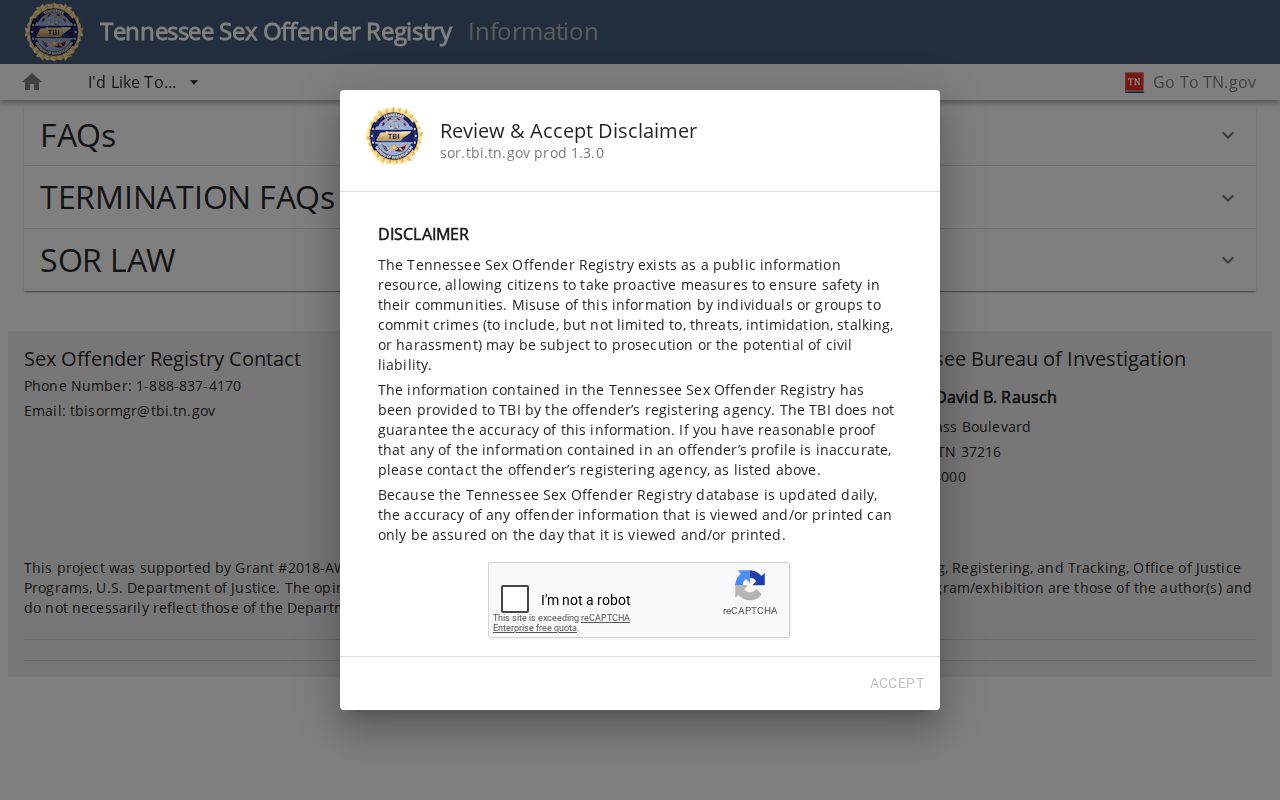
Its warnings belong beside the record because the source, update cycle, and lawful-use limits affect how each result should be read.
Tennessee Sex Offender Registry Searches
TBI operates the state registry and provides both list and map routes. General Search can read several kinds of terms, while dedicated checkboxes limit interpretation to a name or address. For a Maury County view, select Maury from the County dropdown. Include Prisons/Incarcerated changes the result set by bringing incarcerated profiles into view, so note whether it was selected when comparing two searches.
- Open the official registry and accept its conditions of use.
- Enter a name or address, or choose Maury in the County dropdown. Add a status filter only when it serves the search.
- Review the result list, then compare identifiers rather than relying on a name or photo alone.
- Open Full Details to read the address, registering agency, classification, offenses, report dates, and update information.
| Field Label | Type | Required | Notes |
|---|---|---|---|
| General Search | Text | No | Name, alias, address, city, county, ZIP, ID, status, or offense; partial terms; up to 8 terms |
| Include Prisons/Incarcerated | Checkbox | No | Adds incarcerated profiles to results |
| Name Only / Address Only | Checkboxes | No | Limits how the entered terms are interpreted |
| County | Dropdown | No | Select Maury for county results |
| Offender Status | Dropdown | No | Limits results to a portal status value |
| Map Offenders | Map control | No | Opens the geographic view |
The Maury County search is easier to use when its filters are understood before entering a broad term. The official Tennessee registry is the source for this captured interface:
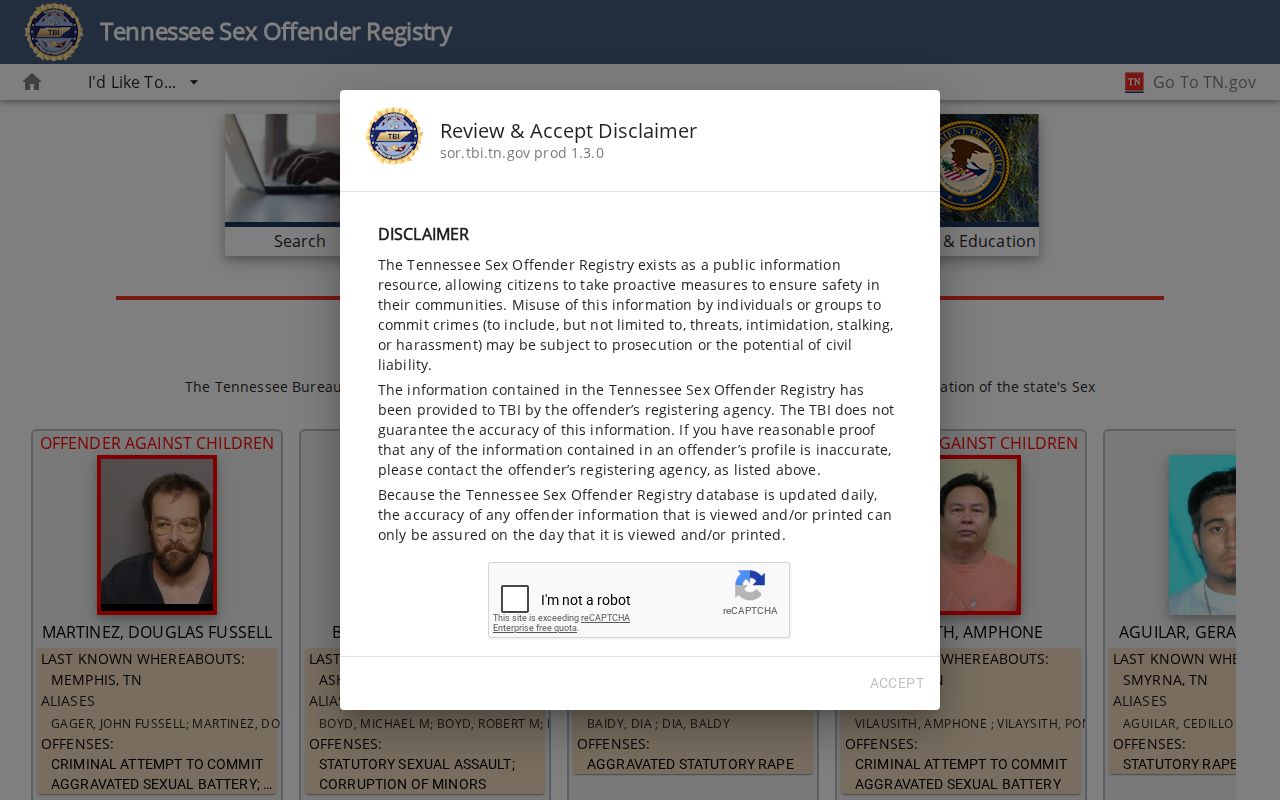
The county dropdown, scope controls, and map option let a searcher move from a statewide list to a focused Maury County view.
Maury Offender Registration Routes
Registration responsibility follows the address. A municipal police department is the registering agency for a location inside a Maury County municipality. The Maury County Sheriff serves an address in unincorporated county territory. This split matters when a person wants to report an apparent address error or other compliance concern. The profile's registering-agency field points to the office that supplied the data and should receive supporting information.
The Maury County registry is not a substitute for reporting urgent conduct to law enforcement. For a profile-data question, preserve the exact field, the date viewed, and any reasonable proof before contacting the named agency. For a registry-system question, TBI maintains the statewide contact. That division gives local agencies the chance to verify facts while TBI maintains the public Tennessee layer.
Registry Profiles: What They Show
A full Maury County profile combines identity, location, offense, and compliance fields. The photo and physical description can help distinguish names, while aliases, birth date, scars, marks, and tattoos add context. Addresses list the city, county, ZIP code, and registering agency. Offense entries may include dates, code descriptions, and public disposition history. Work, school, vehicles, tags, supervision, warrants, or a child-victim flag appear only where they are public and applicable.
| Name and aliases | Full name and other reported names, plus date of birth |
|---|---|
| Photo and description | Race, sex, height, weight, eyes, hair, scars, marks, and tattoos |
| Registered address | Primary or secondary location, city, county, ZIP, and registering agency |
| Offense information | Offense, date, code description, and public history where available |
| Classification | Tennessee classification, not a public federal Tier I, II, or III label |
| Status and dates | Status, last registration or report date, and last information update |
| Other public facts | Vehicles, school, supervision, warrants, or work data when applicable by law |
Read each field on its own terms. A listed offense is not the same field as current registry status. Likewise, a vehicle entry is not an address, and the most recent information update may differ from the last in-person report date. Those distinctions keep a Maury County registry profile from being reduced to one label.
Maury Registry Maps and Alerts
The registry offers two tools beyond a result list. Map Offenders presents the geographic view, which can support neighborhood awareness when the search area is defined with care. Full Details also shows an envelope control that registers an email alert when that specific profile changes. Manage My Email Alerts is the portal control for maintaining those notices.
A Maury County alert reports a profile update. It does not certify why the change occurred, and it should prompt a fresh review of Full Details. The information or tip control provides another way to act on a concrete concern. Use an agency route for a suspected factual error and an emergency channel for an immediate safety issue.
These features support calm safety planning. They do not turn a mapped point into permission to confront, follow, or publish claims about a registrant or household.
Registration Levels and Duties in Tennessee
Tennessee does not use public federal Tier I, II, and III labels as its operative system. The public classifications are Sexual Offender and Violent Sexual Offender, with special lifetime rules for some multiple convictions and specified cases involving a victim age twelve or younger. Verification frequency and the potential end of registration differ sharply. A sexual offender may seek termination only after the statutory waiting point and compliance review. Ten years does not itself remove a person.
| Classification | Duration or Removal Rule | Verification |
|---|---|---|
| Sexual Offender | May request termination no sooner than 10 years after supervision ends or discharge; approval is not automatic | Annual in-person window around birthday |
| Violent Sexual Offender | Lifetime | Quarterly in March, June, September, and December |
| Specified multiple convictions or young-victim cases | Lifetime | Per governing classification |
| Violent Juvenile Sexual Offender | Separate juvenile framework, potentially ending at 25 absent a disqualifying event | Quarterly; generally confidential |
Maury County registrants must report specified residence, work, school, release, and other changes within the time set by law. The annual administrative cost may be up to $150. Registration violations are Class E felonies, with escalating statutory minimums for repeat violations. Tennessee's 1,000-foot rules and exceptions appear in Tenn. Code Ann. §40-39-211, so the current statute controls a particular address question.
Maury Searches Beyond Tennessee
The National Sex Offender Public Website adds the cross-state layer. It is useful when a safety search is not limited to Maury County or when a move may cross Tennessee's border. NSOPW gathers public registry access from participating jurisdictions, but the TBI profile remains the underlying Tennessee source for local detail, status, and registering-agency information.
The national interface gives a Maury County search a broader starting point. This image comes from the official U.S. Department of Justice search listed in the manifest:
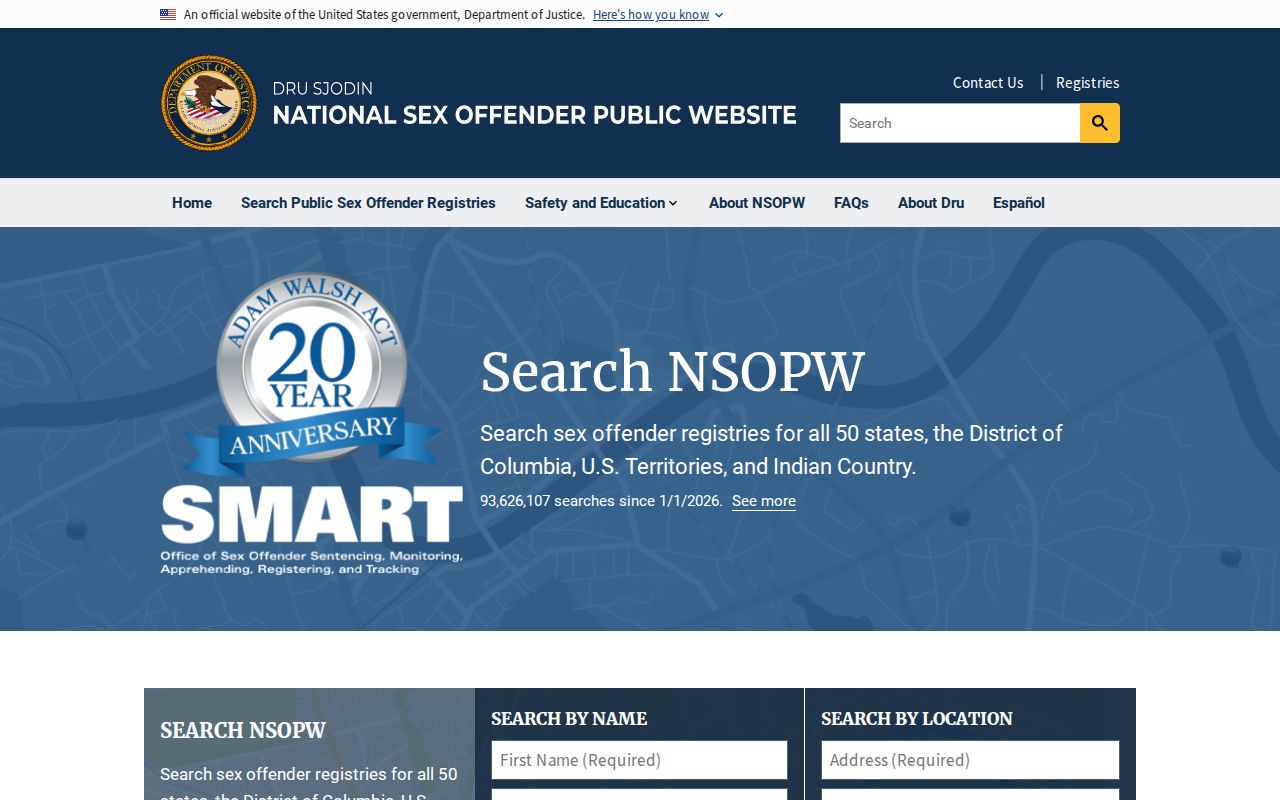
Use a national result to identify the correct jurisdiction, then open that jurisdiction's official profile for its current fields and reporting office.
Maury Registry Removal Is Not Automatic
For a Tennessee Sexual Offender in Maury County, ten years is the earliest point at which termination may be requested after supervision ends or discharge. It is not an automatic expiration date. The decision depends on substantial compliance and the absence of a disqualifying event. Violent Sexual Offender registration is lifetime, as are the specified multiple-conviction and young-victim categories summarized above.
This distinction prevents a common error when reading an old Maury County offense date. The public profile's offense date alone does not establish when supervision ended, whether the person qualifies to petition, whether a petition was filed, or whether termination was granted. Current classification and status fields are more useful than counting years from the offense.
Using Registry Information Lawfully
Tennessee publishes specified adult registry fields under Tenn. Code Ann. §40-39-206. Most violent-juvenile registry information remains protected. Public access supports family safety, neighborhood awareness, address review, and informed use of profile alerts. It does not erase the need to verify the right person, read the registering agency, and note the date of the last update.
Maury County community action should stay tied to lawful channels. Send reasonable proof of bad data to the registering agency. Use TBI's registry contacts for system questions. Report an immediate threat through law enforcement. Do not use a Maury County sex offender lookup to punish a person or household outside legal process.
Misuse warning: Tenn. Code Ann. §40-39-206 makes specified registry data public, but TBI warns that threats, intimidation, stalking, or harassment may bring criminal prosecution or civil liability.
Safety awareness works best when it is factual and measured. A profile is an official public record with defined fields and limits, not an invitation to confront anyone.