
Criminal Court Cases in Maury County
Maury County criminal case records are divided by court level. General Sessions Criminal/Traffic keeps county warrants, misdemeanor dockets, early felony proceedings, and citations issued by the Maury County Sheriff or Tennessee Highway Patrol. Part I serves Columbia. Part II serves Mount Pleasant. Once a grand jury returns an indictment, Circuit Criminal handles the felony trial docket, plea or trial, sentence, and later court action. Circuit Criminal also receives appeals from lower courts and certain transfers from Juvenile Court.
Municipal courts form a separate layer. Columbia, Spring Hill, and Mount Pleasant keep their own city citations and ordinance matters. The Maury County online payment page warns that city-police citations do not belong in the county payment system. A ticket from a city officer may therefore lead to a city docket, not a Maury County General Sessions record. Start with the agency printed on the citation or warrant.
Maury Court Records Moved
The main criminal-record counter moved on October 14, 2024. Circuit Court, General Sessions Part I, Juvenile Part I, and their clerk offices now operate at the Maury County Judicial Center, 1115 South Main Street in Columbia. Older directions may still point to the historic courthouse. The current Circuit Court page is the source to check before a visit.
General Sessions and Juvenile Part II remain at 130 Bluegrass Avenue in Mount Pleasant. Both clerk counters are open Monday through Friday from 8 a.m. to 5 p.m., but they use different phone numbers. Circuit Criminal can be reached at 931-375-1107 or 931-375-1108. General Sessions Criminal/Traffic Part I uses 931-375-1103 through 931-375-1106. Part II uses 931-379-3340. Calling the right counter saves a request from being passed between offices.
Maury County Judicial Center
1115 S. Main St.
Columbia, TN 38401
Circuit Criminal: 931-375-1107 or 1108
Monday through Friday, 8 a.m. to 5 p.m.
General Sessions Part II
130 Bluegrass Ave.
Mount Pleasant, TN 38474
931-379-3340
Monday through Friday, 8 a.m. to 5 p.m.
Maury County Case Record Searches
No public Maury County trial-court name portal was found. The county payment page takes payments but does not provide a broad docket search. A useful search begins by routing the matter to the correct clerk, then giving enough details to distinguish it from a common-name match.
- Identify the issuing agency and decide whether the matter is a city citation, county warrant, misdemeanor, or indicted felony.
- Call General Sessions Part I for Columbia county matters or Part II for the Mount Pleasant counter.
- For an indicted felony, contact Circuit Criminal or visit the Judicial Center with the full name, approximate date, charge, and docket number if known.
- Ask which docket entries and documents are public. Confirm the current plain-copy or certified-copy charge because no official criminal-copy price was published.
- Use Tennessee Public Case History only when the Maury County case reached an appellate court.
For an old file or a record missing from a remote source, the Tennessee court-clerk finder reinforces the basic rule: trial-court records come from the clerk where the case began. That official clerk route is shown in the image below.
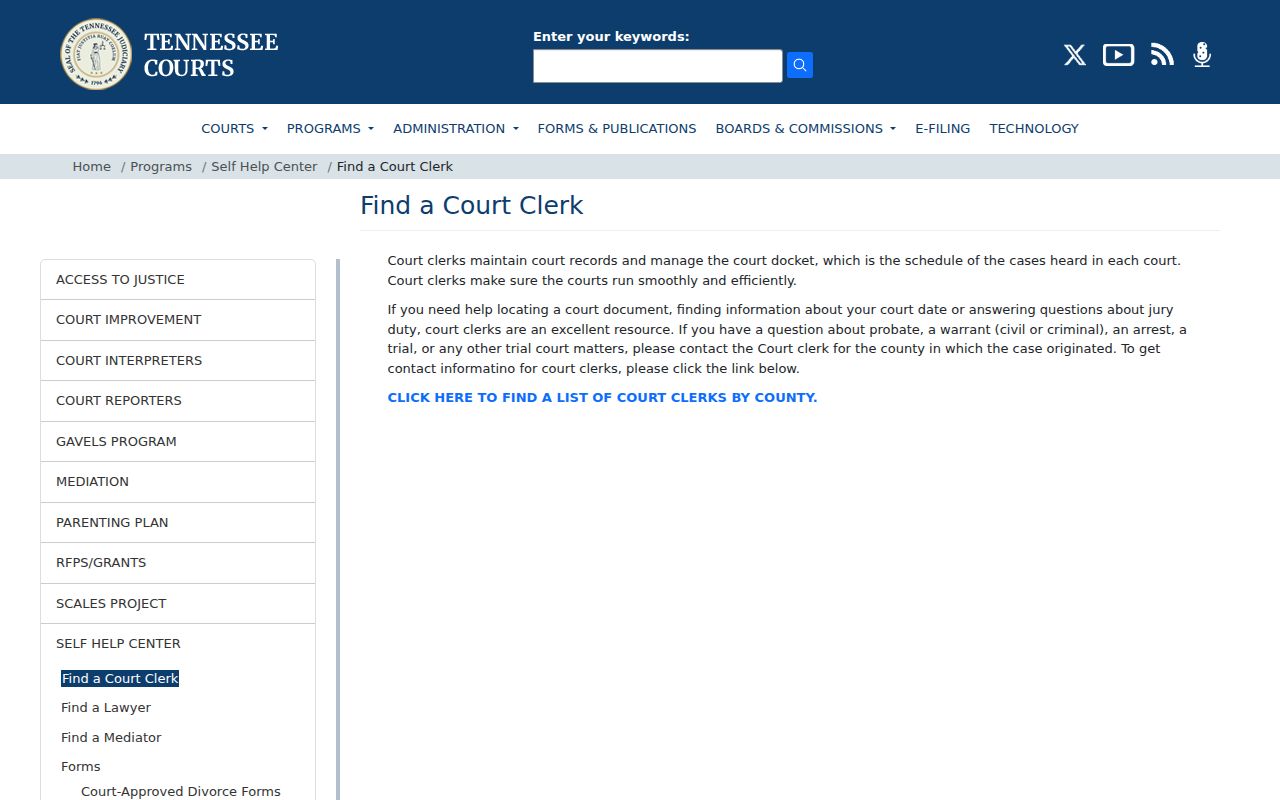
For Maury County criminal matters, that means separating Part I, Part II, Circuit Criminal, and the municipal courts before requesting a file.
Maury General Sessions Court Parts
Part I and Part II belong to the same Circuit Court Clerk organization, yet they are not interchangeable counters. Part I at the Judicial Center handles its Columbia dockets. Part II at Bluegrass Avenue handles its Mount Pleasant dockets. The place of the event and the agency that issued the citation help identify which part has the file.
A Spring Hill matter calls for extra care because the city spans Maury and Williamson Counties. It may be a Spring Hill City Court citation, a Maury County matter, or a Williamson County matter. Likewise, a Columbia Police citation and a Sheriff citation from the same city can route to different courts. Read the issuing agency first, then confirm the court before paying or seeking copies.
Note: A payment sent to the wrong court may delay processing and does not replace a search of the actual docket.
What a Criminal Case File Contains
A Maury County court file follows the prosecution rather than the booking. It organizes the case by number, parties, judge, filings, hearings, charge outcomes, sentence, and financial obligations. The key document depends on the question. The charging instrument shows what the state filed. The docket lists events. A judgment or disposition records how each charge ended. A sentencing order states the court’s final terms.
| Case Number and Court | Identifies the docket and whether General Sessions, Circuit Criminal, or a municipal court holds it. |
|---|---|
| Charging Document | Shows the formal complaint, warrant, citation, information, or indictment that began the court matter. |
| Docket Entries | Lists filings, appearances, motions, orders, and other events in date order. |
| Hearing Dates | Records scheduled and completed court settings, subject to later changes. |
| Disposition and Judgment | States the result for each charge, such as dismissal, nolle prosequi, acquittal, diversion, plea, or verdict. |
| Sentence and Conditions | Shows confinement, probation, restitution, costs, or other terms imposed after conviction. |
Public copies omit or redact Social Security numbers, protected victim data, confidential juvenile information, and material sealed by a court. A public file can also differ from a Tennessee Bureau of Investigation repository report, which is arranged around fingerprint-supported arrest cycles and reported outcomes.
C-Track Covers Maury Appeals
Tennessee Appellate Courts Public Case History, often called C-Track, searches the Supreme Court, Court of Appeals, and Court of Criminal Appeals. It covers matters whose appellate record was filed after September 1, 2006. Its data is current through the prior business day. This is not a statewide Maury County trial-docket search.
The official C-Track interface pictured below accepts several ways to find an appeal. No single field is required except the action that runs the search.
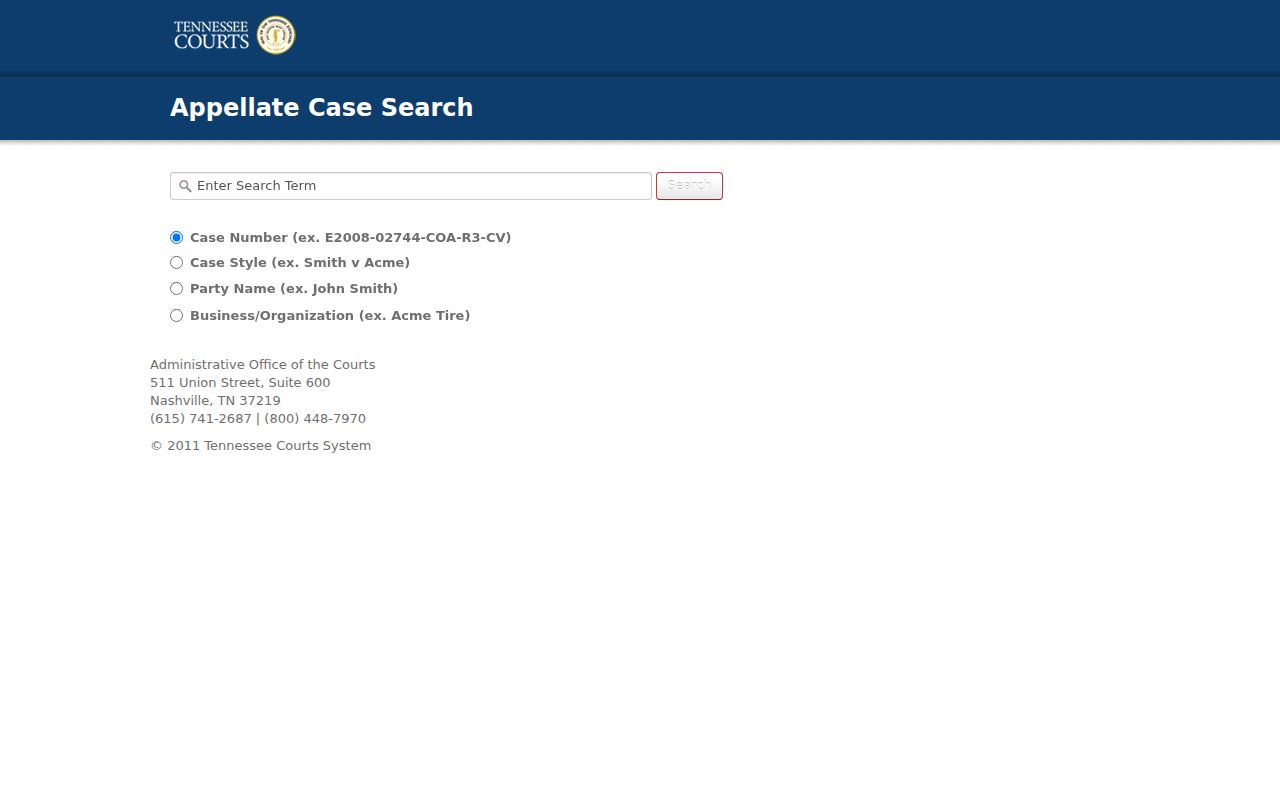
Use a case number when available. A party name or part of the case style can help when the number is unknown, but a common-name result still needs confirmation against the trial court and trial-court number.
| Field | Type | Required | Use |
|---|---|---|---|
| Case Number | Text | No | Enter the full number or a contained numeric sequence. |
| Case Style | Text | No | Search part of the caption or style. |
| Party Name | Text | No | Use a first or last name. |
| Business/Organization | Text | No | Find an organization named as a party. |
| Advanced Search | Control | No | Opens more filters. |
Criminal Case Stages in Maury County
A local criminal case may begin with a warrant or citation in General Sessions. After an arrest, a magistrate at the Lawson White Drive complex conducts an initial appearance shortly after arrival, considers probable cause where required, and sets bond. That office does not keep the court docket. General Sessions handles the early file, a misdemeanor through disposition, or the preliminary phase of a felony.
If the grand jury returns an indictment, the felony moves into Circuit Criminal Court. Pleas, motions, hearings, a plea or trial, judgment, and sentencing then appear in that court record. An appeal adds a separate appellate history. The trial clerk remains the source for the underlying Maury County pleadings.
Case flow: Charges Filed › Arraignment › Pretrial › Plea or Trial › Disposition › Sentencing
Reading a Maury Appeal
C-Track divides an appellate result into five useful views. Case Overview gives the appellate number, case style, trial court, trial judge, and trial-court number. Case Milestones lists dates for the application, record filing, completed briefing, argument or submission, decision, disposition, and closure. Parties identifies each role and counsel.
Document History may link motions, orders, judgments, opinions, mandates, letters, and other filings. Record Information describes the technical record, transcript of evidence, and exhibits sent up from the trial court. Those tabs can prove that an appeal occurred and show its outcome, but they do not reproduce every General Sessions or Circuit Criminal filing. Return to the Maury County clerk when the needed document is part of the trial record.
- Mandate
- The appellate court’s formal direction returning the result to the lower court.
- Technical record
- The filed pleadings and orders transmitted from the trial court for appellate review.
- Transcript of evidence
- The record of testimony or proceedings included for the appeal.
Maury Case Outcomes Differ
Read each charge on a Maury County docket separately. A nolle prosequi means the prosecutor formally chose not to continue that charge at that time. A dismissal ends a charge without a conviction on it. An acquittal is a not-guilty result after trial. Judicial diversion postpones judgment for a qualifying person who must complete court conditions and may later seek dismissal and expungement.
A conviction is a judgment of guilt by plea or verdict. It may carry confinement, probation, restitution, or other conditions. None of these outcomes should be inferred from the original arrest charge. The booking record captures the allegation at intake, while the court file records what prosecutors filed and how the judge resolved each count. A dismissal also does not by itself mean that all public records were expunged.
Access Rules for Case Records
Tennessee Supreme Court Rule 34 governs access to judicial records, including procedures, charges, and exemptions. The official Tennessee court rules provide the current text. Court access differs from a Sheriff report request under the Tennessee Public Records Act. Ask the originating clerk for a docket or filed court document.
Ordinary public access does not include every item. Confidential juvenile cases, sealed or expunged documents, protected victim information, Social Security numbers, financial-account identifiers, and some investigative material may be withheld or redacted. Maury County Juvenile Court limits record requests to legal parties who appear with valid photo identification. Grand-jury deliberations remain secret, even though a returned indictment becomes part of a court record.
A person reviewing a local prosecution can place its later outcome beside the original booking by consulting the county arrest search routes. The two records answer different questions and should not be treated as substitutes.